

|
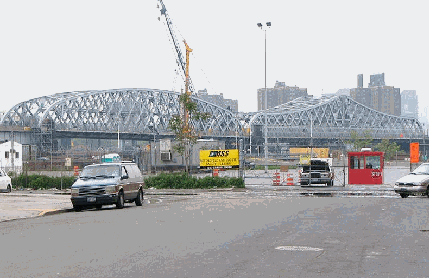
This 2009 photo shows the Willis Avenue Bridge looking south from the Bronx construction staging site. This bridge replacement project was completed in 2010. (Photo by Kevin Walsh, www.forgotten-ny.com.) |
||

|
BUILT TO RELIEVE THE THIRD AVENUE BRIDGE: At the end of the nineteenth century, massive industrial development in the Bronx prompted officials in the newly unified "Greater New York" to find ways to connect residents in northern Manhattan with the new jobs. While the Third Avenue Bridge stood about one-half mile north along Harlem River, the bridge, which was reconstructed in the 1890s, was already reaching capacity. |
||
|
In July 1894, the commissioner of public works empowered the City of New York to "build a bridge beginning at First Avenue and 125th Street, thence northeasterly or nearly so, to and across Harlem River, to and along Willis Avenue to 134th Street" in the Mott Haven section of the Bronx. The point selected for crossing the Harlem River, a location where ferries had run since 1667, crossed the terminal yard of the New York, New Haven and Hartford Railroad. Once completed, the bridge was to be operated free of tolls by the newly created Department of Bridges. The department tapped Thomas C. Clarke to design the new bridge. |
||
|
As the bridge was being constructed, alterations were made to the original plans for incandescent lights, increased boiler and dynamo power (using electric rather than steam power), four pedestrian shelters on rest piers, an improved end-lift system, and the use of cement instead of asphalt on the roadway and sidewalks. These alterations added to the cost of the bridge, and it soon became evident that the $2 million allowed by the 1894 legislation would be insufficient to pay the entire cost. At the request of city officials, the New York State Legislature allocated additional funds for the bridge's completion. The Willis Avenue Bridge opened to traffic on August 22, 1901 at a cost of $2.5 million. |
||
|
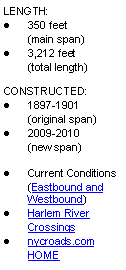
DESIGN AND CONSTRUCTION: Designed by Thomas C. Clarke, who also created plans for the Third Avenue Bridge, the Willis Avenue Bridge features a 304-foot-long draw span that swings perpendicular to the approach roadways. When opened, vessels in the Harlem River are permitted to travel through two 108-foot-wide channels. When closed, the bridge permits 24 feet of vertical clearance. |
||
|
CONNECTING TO THE STREET GRID: At the southern approach in Harlem, First Avenue and East 125th Street connect directly to the bridge. A ramp from the northbound FDR Drive (at EXIT 18), which opened in 1936 during the Triborough Bridge-East River Drive improvement project, also connects to the bridge. At one time, a third ramp had been proposed from East 127th Street and Second Avenue, but this plan was later shelved. At the northern terminus in the Bronx, the Willis Avenue Bridge empties onto Willis Avenue near the Major Deegan Expressway. A direct ramp connecting to Bruckner (Southern) Boulevard opened in 1907. Until 1972, the bridge carried the NY 1A designation. |
||

|
REBUILDING THE WILLIS AVENUE BRIDGE: In late 1999, the New York City Department of Transportation (NYCDOT), the New York State Department of Transportation (NYSDOT) and the Federal Highway Administration (FHWA) proposed two alternatives to address structural and seismic deficiencies, increase the load carrying capacity, improve safety, and enhance bicycle and pedestrian facilities on the bridge. Incorporated into and studied with the "rehabilitation" and "rebuild" alternatives were design variations of bridge type (moveable or fixed) and materials (concrete or steel). In 2001, the three agencies decided to replace the existing span with a new swing bridge, which at the time was estimated to cost $278 million. |
||
|
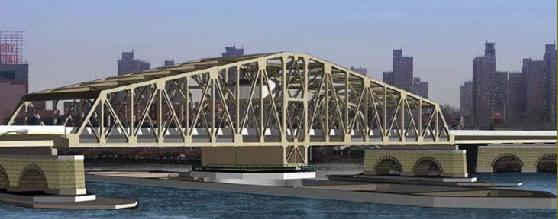
Artist's rendition of the new Willis Avenue Bridge, which opened to traffic on October 2, 2010. (Photo by New York City Department of Transportation.) |
||

|
Type of bridge |
||
|
Swing |
||


|
SOURCES: The Bridges of New York by Sharon Reier, Quadrant Press (1977); "A Guide to Civil Engineering Projects in and Around New York City," American Society of Civil Engineers (1997); "Willis Avenue Bridge: Letter of Intent," Federal Highway Administration and New York State Department of Transportation (1999); "Mayor: Replace the Creaky Willis Avenue Bridge," Bronx Press Review (5/04/2000); "Plan To Cut Construction Spending Would Delay Willis Avenue and Brooklyn Bridge Projects" by Michael Cooper, The New York Times (2/21/2002); "Want To Buy a Bridge?" by Michelle Charlesworth, WABC-TV (1/13/2006); "New York City Has A Bridge To Sell, Really" by Sewell Chan, The New York Times (1/14/2006); "Replacement of the Willis Avenue Bridge Over the Harlem River," New York City Department of Transportation (2007); "Heads Turn As a Bridge Floats By" by Corey Kilgannon, The New York Times (7/13/2010); "New Willis Avenue Bridge Arrives in Harlem" by Stephen Nessen, WNYC Radio (7/26/2010); "New Willis Avenue Bridge Opens" by Tom Namako, New York Post (10/02/2010); New York City Department of Transportation; Bill Armstrong; Kevin Walsh. |
||
|
WILLIS AVENUE BRIDGE LINKS: |
||

|
WILLIS AVENUE BRIDGE VIDEO LINKS: |
||

|
WILLIS AVENUE BRIDGE CURRENT CONDITIONS: |
||


|
PEDESTRIAN AND BICYCLE ACCESS: |
||

|
|
||

|
Back to The Crossings of Metro New York home page. |
||
|
Site contents © by Eastern Roads. This is not an official site run by a government agency. Recommendations provided on this site are strictly those of the author and contributors, not of any government or corporate entity. |
||