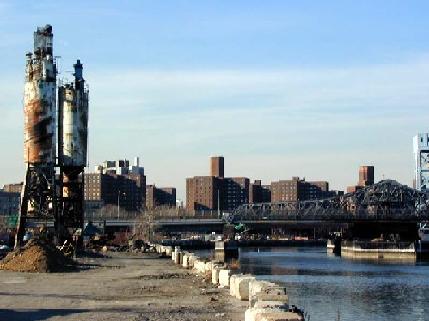
View of the Third Avenue Bridge from the Manhattan shoreline of the Harlem River. Just to the north of the Third Avenue swing bridge is the Metro-North railroad lift bridge. (Photo by Wired New York.)
THE FIRST BRIDGE (1797): As early as 1774, officials in the New York colony proposed a fixed Harlem River crossing between Harlem and the Mott Haven section of the Bronx. That year, Colonel Lewis Morris of the Manor of Morrisiana - just to the north of Mott Haven - applied to the New York Common Council for permission to construct a new bridge to connect New York with the Bronx (which was part of Westchester County until 1914), and eventually to Boston via the new Boston Post Road.
In 1790, the new State Legislature passed, and the governor signed, a law giving Morris authority to construct a bridge to carry Boston Post Road, as Third Avenue as then known in the southern Bronx and Manhattan. The bridge was to be "not less than 30 feet wide, and between the center arches thereof there shall be an opening not less than 20 feet, over which these shall be a draw not less than 12 feet for the free passage of vessels with fixed standing masts." The legislation also gave Morris the authority to collect tolls for 60 years. Finally, the legislation charged the highway commissioner of New York the authority to construct the new Boston Post Road.
After Morris failed to carry out his authority, the state assigned his rights to John B. Coles in 1795. Under new legislation, the state granted Coles the right to build a dam for the use of nearby mills. The dam was to also serve as a foundation for a bridge. The revised plans called for a bridge not less than 24 feet wide, and the dam (which was to be attended at all times) was to have a lock eight feet wide and two feet deep. Coles was required to give security of 4000 pounds to New York State to complete the bridge in four years, and after a 60-year period (during which Coles had the right to collect tolls), the bridge was to become the property of the state.
The new "Coles Bridge" - as the bridge was originally called - opened to traffic in 1797. With the opening of the new Boston Post Road, the bridge became part of an important route between New York and New England. In 1808, Coles set up a separate entity, the Harlem Bridge Company, with capital of $40,000. The new company, which was responsible for maintaining the bridge and nearby approaches, had a complicated rate structure ranging from one penny for cattle to 37 cents for carriages.
THE SECOND BRIDGE (1868): Under a law passed by the state legislature in 1857, as well as under previous legislation, ownership of the "Coles Bridge" was transferred from the Harlem Bridge Company to the state of New York in 1858. The 1857 legislation created a "Harlem Bridge Commission" comprised of officials from New York and Westchester counties, and the commission had the power to either maintain the existing structure or construct a new bridge.
When ownership was transferred, the state found the bridge structurally deficient, and undertook an immediate rehabilitation program. Despite the extensive repairs, a commission established by the mayor of New York in 1859 reported that the bridge can be "rendered tolerably safe for a short time", but recommended that repairs be made at small expense, as a new bridge must be built "if the Harlem River must continue to be obstructed with such structures."
The second bridge, which was constructed just to the north of the old bridge, opened to traffic in 1868. The 526-foot-long cast-and-wrought iron bridge (measured between approaches) had a 218-foot-long swing span, two 80-foot-wide navigable channels, and a 52-foot-wide roadway. Its engine was operated by water from the nearby Croton aqueduct.
In the early 1870s, jurisdiction over the bridge was transferred to the New York City Parks Department. With the city's annexation of the towns of Morrisania, West Farms, and Kingsbridge, Westchester County was absolved of all responsibility over bridges crossing the Harlem River.
Rail traffic over the Harlem River was permitted for the first time when a newly established entity, the Morrisiana and Fordham Railroad Company, received permission from the state to run rails on the bridge. The railroad cars were driven by a horse-run system until 1891, when an overhead trolley system was installed.
THE THIRD BRIDGE (1898): Despite the engineering success of the new bridge, repairs became more frequent in the ensuing years. Increased road and river traffic necessitated increased maintenance expenditures. Specifically, the cast iron cylinders of the piers cracked, the cast iron wheels of the turntable split and had to be renewed, the hydraulic engine was found to be too slow and a team engine was substituted for it. Furthermore, the bridge appeared to be buckling under its own immense weight: the ornamentation alone weighed about 100 tons.
Between 1886 and 1891, both bridge and river users petitioned local, state and Federal authorities. On September 9, 1891, the New York City parks commissioner made his recommendation as follows:
The Board reached the unanimous conclusion and reported that (the Third Avenue Bridge) in question, even as operated under the existing regulations, were obstructions to navigation, which, under the laws of the United States, ought to be removed. They further found and reported that the remedy for the evil that would best satisfy the just demands of travel over and travel under the bridges to increase the span of the draws and to raise the bridges to a clear height of 24 feet above high water.
The Secretary of War, upon the report, and in pursuance of the status above cited, has ordered the city and the railroad company to change their respective bridges according to these requirements.
In 1892, the New York State Legislature authorized construction of the new Third Avenue Bridge, and allocated $1.5 million for construction and right-of-way acquisition. The bridge was to be rebuilt in conjunction with an Army Corps of Engineers project to construct the Harlem River Ship Canal, which was to provide a navigable channel between the East River and the Hudson River. Construction began in November 1893 upon approval from the War Department. In 1896, the state legislature allocated an additional $2.5 million.
While construction of the new bridge was underway, the New York City Department of Public Works diverted traffic to a temporary span just south of the old bridge. Once the temporary span opened, the old bridge was torn down. The temporary timber-and-iron draw span, which was constructed at a cost of $42,000, operated for more than four years.
On August 1, 1898, the newly established Department of Bridges opened the Third Avenue Bridge to vehicular traffic at a cost of $4.0 million. Pedestrians could not use the bridge until 1901, when new sidewalks were installed on the bridge.
DESIGN AND CONSTRUCTION: Designed by Thomas C. Clarke, who also created plans for the Willis Avenue Bridge, the Third Avenue Bridge features a 300-foot-long draw span that swings perpendicular to the approach roadways. When opened, vessels in the Harlem River are permitted to travel through two 102-foot-wide channels. When closed, the bridge permits 25 feet of vertical clearance.
The swing span is comprised of continuous trusses supported by a drum girder at the center pivot pier, and toggle end lifts on the approach piers. At the level of the bottom chords, a floor system provides for a 52-foot-wide roadway that accommodates four lanes of southbound traffic. On each side of the bridge, there are two 9-foot-wide sidewalks. Opening and closing of the rim-bearing swing bridge is accomplished by hydraulic machinery. When the bridge is operated, the machinery rotates with the draw. Operation of the bridge is controlled from the operator's house, which is located on a platform that spans over the roadway.
The foundations were constructed using caissons and cofferdams. Once the foundations were set, masonry piers were erected. To protect the piers, spruce, oak and pine pilings were used as fenders.
RAIL SERVICE ON THE BRIDGE: The Union Railway Company, which was the successor to the Harlem Bridge, Fordham and Morrisania Railway Company, installed rails and operated continuous service on the new Third Avenue Bridge. Service on the bridge continued until 1953, when the bridge was rehabilitated and the Third Avenue Elevated was torn down in Manhattan.
After the trolleys stopped running, the center lane was for use by motor vehicles, and eventually the inside trusses (part of the original design), which in themselves constituted a complete bridge, were sold by the Terry Contracting Company. In 1955, the firm placed the following advertisement in The New York Herald-Tribune:
Wanna buy a bridge? Steel swing bridge, 300 feet long, 63 feet wide, can carry 100,000 vehicles, 500,000 pedestrians or 10 million chickens daily. Terrific bargain! Cash and carry, or will install anywhere in the world.
CONNECTING TO THE STREET GRID: The Third Avenue Bridge carries four lanes of southbound traffic between the Bronx and Harlem. At the northern approach in the Bronx, both Third Avenue (which was widened in preparation for the bridge) and Bruckner (Southern) Boulevard provide easy access. No direct access is provided from the nearby Major Deegan Expressway (I-87). At the southern terminus in Harlem, the bridge empties onto Lexington Avenue near East 130th Street, and onto East 129th Street near Third Avenue. Access from the bridge to the southbound Harlem River Drive is also provided.
On August 5, 1941, the city began one-way operation on the Third Avenue Bridge and the nearby Willis Avenue Bridge. Until 1972, the bridge also carried the NY 1A designation.
A FOURTH BRIDGE FOR THIRD AVENUE (2004): On the night of November 7, 1999, part of the 120-foot-long wooden fender under the swing span caught fire, sending flames 50 feet into the air. Although there was no damage to the main swing span, the bridge was shut down for several days while construction crews replaced the damaged fender.
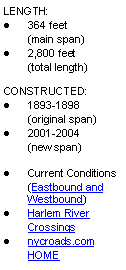
In July 2001, the NYCDOT began a $118 million reconstruction of the Third Avenue Bridge. The entire bridge, including the approach ramps, was replaced on the same alignment as the existing span. In July 2004, a new state-of-the-art, 1,900-ton swing span was barged 1,800 miles from the fabrication site in Mobile, Alabama to the construction site. The new span measured 364 feet in length (64 feet more than the old span) and 88 feet wide (two feet wider than the old span). New mechanical and electrical systems also were installed. The project was completed in November 2005.
According to the New York City Department of Transportation (NYCDOT), the bridge carries approximately 75,000 vehicles per day (AADT). Because of its close proximity to the Triborough (RFK) Bridge, the Third Avenue Bridge serves as a toll-free, heavily traveled alternative route to the nearby toll bridge.
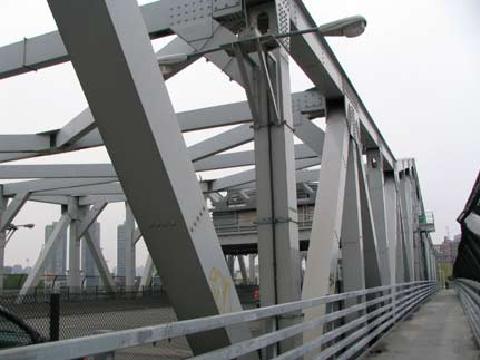
This 2009 photo shows the pedestrian path of the new Third Avenue Bridge looking southwest toward Manhattan. (Photo by Kevin Walsh, www.forgotten-ny.com.)
Type of bridge Construction started Opened to traffic New span opened to traffic Length of main span Length of two channels Total length of bridge and approaches Width of bridge Width of roadway Number of traffic lanes Clearance at center above mean high water Steel used in swing span Steel used in structure Masonry used in structure Foundation type Cost of original structure Cost of new structure
SOURCES: The Bridges of New York by Sharon Reier, Quadrant Press (1977); "A Guide to Civil Engineering Projects in and Around New York City," American Society of Civil Engineers (1997); "DOT To Start Third Avenue Bridge Reconstruction," The Bronx Times (9/26/2002); Bronx Historical Society; G&G Steel, Inc.; New York City Department of Transportation; Bill Armstrong; Kevin Walsh.
NY 1A shield by Ralph Herman. Lightpost by Jeff Saltzman.